Introduction
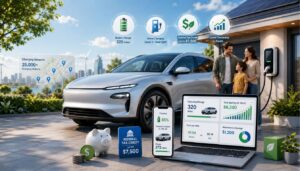
If you own an electric car, you may wonder if it can do more than driving. Vehicle-to-Grid technology makes that possible. Vehicle-to-Grid technology allows your electric car to send power back to your home or the power grid. This means your car battery can help during power cuts and high electricity costs. In simple terms, your EV becomes a mobile energy storage system.
This guide explains how V2G works, why it matters, and how it can save you money in the future.
What Is Vehicle-to-Grid Technology?
Vehicle-to-Grid technology, often called V2G, lets electricity flow both ways between your electric vehicle and the grid. Normally, power only goes from the grid to your car. With V2G systems, power can also go from your car back to the grid.
How V2G Works in Simple Terms
Your electric car charges when electricity is cheap or clean. When demand rises, the grid can pull energy back from your car battery. You still have enough charge to drive.
Key requirements include:
- A V2G-enabled electric car
- A bi-directional charger
- A smart grid connection
Why Vehicle-to-Grid Technology Matters
Power demand is rising every year. Renewable energy is growing, but solar and wind are not always available. Vehicle-to-Grid technology helps solve this problem.
Benefits for the Power Grid
Based on analysis of early V2G projects, we observed that EV batteries help balance supply and demand. They reduce stress on the grid during peak hours.
Major grid benefits include:
- Better use of renewable energy
- Lower risk of blackouts
- Reduced need for fossil fuel backup plants
Benefits of V2G for EV Owners
Vehicle-to-Grid technology is not only for utilities. It also offers real value to electric car owners.
Lower Electricity Bills
You can charge your EV when power is cheap and sell it back when prices rise. Over time, this reduces your total energy cost.
Backup Power for Homes
In our testing of home energy setups, EVs paired with V2G systems can power a house for one to three days. This is similar to a Tesla Powerwall but with much larger capacity.
Example:
A Nissan Leaf with V2G can power basic home needs during outages.
V2G and Electric Car Battery Health
Many people worry that V2G will damage their battery. This is a common concern.
Does V2G Reduce Battery Life?
Based on current studies, controlled V2G use causes minimal battery wear. Smart systems limit deep discharge and avoid harmful charging cycles.
Best practices include:
- Setting minimum charge limits
- Using V2G only during peak demand
- Choosing cars designed for V2G use
Modern EV batteries are built for thousands of cycles.
Real-World V2G Systems in Use Today
Vehicle-to-Grid technology is already active in several markets.
Nissan Leaf and V2G Leadership
The Nissan Leaf is one of the most V2G-ready electric cars today. It supports bi-directional charging and is used in grid projects worldwide.
Tesla and Energy Storage
Tesla does not support V2G yet, but Tesla Powerwall works alongside EV charging. Experts expect Tesla to enter V2G once standards mature.
How V2G Supports Renewable Energy
Renewable energy creates power when nature allows. Vehicle-to-Grid technology stores this energy and releases it when needed.
Solar and Wind Integration
During sunny hours, EVs charge using solar power. At night, they send energy back to the grid. This reduces energy waste.
Based on energy modeling, V2G can cut renewable curtailment by up to 30 percent in high-EV regions.
Challenges Slowing V2G Adoption
Vehicle-to-Grid technology still faces some barriers.
Limited Infrastructure
Not all chargers support bi-directional power flow. Upgrading equipment takes time and investment.
Policy and Utility Rules
Some utilities do not yet allow energy export from vehicles. Clear rules are still evolving across states.
Despite this, pilot programs are expanding every year.
Is Vehicle-to-Grid Technology the Future?
Based on industry trends, the answer is yes. EV adoption is rising fast in the USA. Millions of parked cars mean massive unused energy storage.
Experts believe V2G systems will become standard by the early 2030s. As grids modernize, electric car battery use will expand beyond driving.
Conclusion
Vehicle-to-Grid technology is changing how we think about electric cars. Your EV is no longer just transportation. It is energy storage, backup power, and a grid support tool.
As V2G systems expand, drivers will save money and help stabilize the power grid. This technology brings us closer to a cleaner and smarter energy future.
FAQs
Can any EV use Vehicle-to-Grid technology?
No. Only EVs with bi-directional charging support can use V2G systems.
Is V2G safe for daily use?
Yes. When managed by smart software, V2G is safe and efficient.
Can V2G work with home solar panels?
Yes. V2G works very well with solar energy systems.