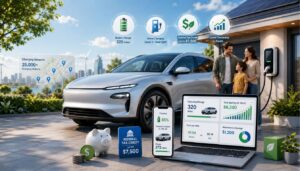
Buy an electric car in 2026 comes down to five decisions: how much range you need, where you’ll charge, which federal or state incentives you qualify for, which EV fits your budget, and whether to lease or buy. This guide walks through every step with specific recommendations for US buyers.
Buying an electric car is not complicated, but it is different enough from buying a gas vehicle that a lot of first-time EV shoppers walk into dealerships or open Tesla’s website without asking the right questions.
Range anxiety is the thing everyone worries about. It’s usually not the real issue. The real questions are: where will you charge this car on a daily basis, does the federal tax credit apply to your situation, and is the model you’re considering actually in stock at a price that makes sense?
This guide covers every step of the EV purchase process in detail, budget, range, charging setup, federal and state incentives, how to compare models, what the lease vs. buy math looks like, and the specific models worth considering in 2026 for each type of buyer.
If you already know what you want and need specific comparisons, jump to the model sections. If you’re starting from scratch, work through each section in order.
Step 1: Set Your Budget Including What You’ll Actually Pay After Incentives
The sticker price of an electric car is not what you’ll pay. The federal Clean Vehicle Credit under the Inflation Reduction Act can reduce your purchase price by up to $7,500 for new EVs and up to $4,000 for used EVs if the vehicle and your income qualify.
This matters a lot when setting a budget. A vehicle listed at $45,000 may cost you $37,500 after the federal credit. A $35,000 EV that doesn’t qualify for the credit costs more out of pocket than a $42,000 EV that does.
How the Federal EV Tax Credit Works in 2026
The federal EV tax credit is worth up to $7,500 for new electric vehicles purchased at qualifying dealerships. Starting in 2024, you can take this credit as a point-of-sale discount meaning the dealer reduces your purchase price immediately rather than waiting to file taxes.
Key rule: The credit only applies if you buy (not lease, in most cases) and the dealer transfers the credit to you at point of sale. Confirm this with the dealer before signing.
Income limits apply. For 2026, the credit phases out above:
- $150,000 adjusted gross income for single filers
- $225,000 for head of household
- $300,000 for married filing jointly
Vehicle MSRP caps also apply:
- Sedans and wagons: must be under $55,000 MSRP
- SUVs, vans, and trucks: must be under $80,000 MSRP
North American assembly is required. Vehicles not assembled in North America do not qualify. Some models from Korean and European manufacturers have not historically met this requirement, though this changes as manufacturers adjust their supply chains. Always verify eligibility on the IRS Clean Vehicle Credit page (IRS.gov) or the Department of Energy’s AFDC vehicle search (fueleconomy.gov) before purchase.
State and Utility Incentives
Several US states offer additional rebates or credits on top of the federal credit. California’s Clean Vehicle Rebate Project, Colorado’s EV tax credit, and New York’s Drive Clean Rebate are among the more substantial programs. Many utility companies also offer home charging installation rebates or reduced overnight electricity rates for EV owners.
Action step: Check your state’s energy office website and your utility company’s EV page before finalizing your budget. Combined with the federal credit, total savings can reach $10,000–$12,000 in some states.
Total Budget Framework
| Budget Range (After Incentives) | What You Can Get | Examples |
| Under $25,000 | Compact EVs, used certified EVs | Used Chevy Bolt EV, Certified Used Nissan Leaf |
| $25,000–$35,000 | Entry EVs, used Model 3, PHEV options | Chevy Equinox EV, Nissan Ariya (entry), Used Tesla Model 3 |
| $35,000–$50,000 | Mid-range EVs the sweet spot in 2026 | Tesla Model Y, Hyundai Ioniq 6, Ford Mustang Mach-E, VW ID.4 |
| $50,000–$70,000 | Premium EVs, trucks, 3-row SUVs | Rivian R1S, Tesla Model X, BMW iX, Rivian R1T |
| $70,000+ | Luxury and performance EVs | Lucid Air, Mercedes EQS, Tesla Model S Plaid, Porsche Taycan |
Step 2: Figure Out How Much Range You Actually Need
Range is the most talked-about EV spec and the most misunderstood one. The EPA-rated range of an electric car tells you approximately how far it can travel on a full charge under standardized test conditions. Real-world range is typically 10–15% lower than EPA figures, depending on driving speed, temperature, climate control use, and load.
Before you anchor on a specific range number, ask yourself one question: how far do you drive on a typical day?
The average American drives 37 miles per day (US Department of Transportation data). Even a 200-mile-range EV on the lower end of the current market provides more than five days of average driving without charging.
Range Needs by Driver Type
| Driver Type | Daily Miles | Minimum Range Recommended | Notes |
| City commuter | 20–40 mi/day | 150–200 miles | Level 2 home charging covers 95%+ of needs |
| Suburban commuter | 40–70 mi/day | 200–250 miles | Home charging sufficient for most days; DC fast charge on occasional long days |
| Long-distance commuter | 70–100 mi/day | 250–300 miles | Home charging + workplace charging strongly recommended |
| Road tripper / rural driver | Varies | 300+ miles | Charging infrastructure matters as much as range; check charging network coverage on your routes |
| Multi-car household | Varies | 200+ miles acceptable | EV handles daily driving; ICE vehicle for infrequent long trips |
Cold Weather and Range Loss
If you live in a cold-weather state the Midwest, Northeast, Mountain West factor in winter range loss. Lithium-ion batteries lose 20–40% of their rated range in very cold temperatures (below 20°F). Running the cabin heater compounds this. Most premium EVs include heat pump systems that recover some efficiency, but winter range loss is real and should factor into your minimum range decision.
If you’re in Minnesota, Wisconsin, Michigan, or similar climates, add 30–40% to your minimum range requirement when shopping. A car rated at 300 miles may deliver 180–210 miles on a hard winter day.
Top-Selling EVs by EPA Range (2026)
| Vehicle | EPA Range | Starting MSRP | Qualifies for Federal Credit? |
| Tesla Model Y Long Range AWD | 330 miles | $48,990 | ✓ Yes (verify current eligibility) |
| Tesla Model 3 Long Range AWD | 358 miles | $45,990 | ✓ Yes (verify current eligibility) |
| Hyundai Ioniq 6 SE Long Range RWD | 361 miles | $38,615 | Check assembly requirements apply |
| Mercedes EQS 450+ | 350 miles | $104,400 | ✗ No (over MSRP cap) |
| Rivian R1T (Standard Pack) | 270 miles | $69,900 | ✓ Yes (under $80K truck cap) |
| Ford Mustang Mach-E Premium AWD | 270 miles | $47,995 | ✓ Yes (verify) |
| Chevy Equinox EV LT | 319 miles | $34,995 | ✓ Yes strong value option |
| BMW i4 eDrive40 | 301 miles | $53,200 | Check assembly requirements apply |
| Kia EV6 Wind AWD | 274 miles | $46,495 | Check assembly requirements apply |
| Volkswagen ID.4 Pro S AWD | 255 miles | $46,760 | ✓ Yes (assembly in Chattanooga, TN) |
Note on specs: Prices and ranges reflect publicly available 2026 model year data. Verify current pricing and tax credit eligibility directly with dealers and at fueleconomy.gov before purchase, as these figures change.
Step 3: Plan Your Charging Setup Before You Buy an Electric Car
Charging is where many first-time EV buyers discover what they didn’t think about. Unlike filling a gas tank, EV charging is something you do at home, at work, at shopping centers and it’s fundamentally different depending on which charger level you’re using.
The Three Levels of EV Charging
| Level | Speed | Equipment | Best For | Cost |
| Level 1 (120V) | 3–5 miles of range per hour | Standard household outlet no installation needed | Plug-in hybrids; low-mileage EV drivers who charge overnight | Free (electricity only) |
| Level 2 (240V) | 15–30 miles of range per hour | EVSE home charger requires electrician installation | Daily EV drivers the standard home charging setup | $500–$1,500 installed (rebates often available) |
| DC Fast Charge (Level 3) | 150–350+ miles of range in 20–45 min | Public charging stations: Tesla Supercharger, Electrify America, EVgo | Road trips and emergency top-ups | $0.20–$0.40/kWh at public stations |
Do You Need a Level 2 Home Charger?
For most daily EV drivers, yes. A Level 2 charger (240V) can fully recharge most EVs overnight typically in 6–10 hours depending on the car’s onboard charger capacity. This means you wake up every morning with a full battery.
Level 1 charging (a standard 120V outlet) adds only 3–5 miles per hour, which works for plug-in hybrids with 20–40 mile electric ranges but falls short for a 300-mile battery-electric vehicle if you’re driving more than 30–40 miles a day.
Installation cost tip: The federal tax credit includes a 30% credit on home charging equipment and installation costs (up to $1,000) under the Alternative Fuel Vehicle Refueling Property Credit. Check IRS Form 8911 for details.
Apartment and Condo Owners
If you don’t have a garage or dedicated parking with electrical access, your charging options are more limited. Some apartments are installing Level 2 chargers in parking structures to ask your building management. Public charging networks (Electrify America, EVgo, ChargePoint, Blink) are expanding rapidly in urban areas. A Tesla in an urban market may work reasonably well using Superchargers alone if your daily driving is moderate, but it requires more planning than home charging.
If you rely entirely on public charging, factor charging costs into your budget. Public DC fast charging typically runs $0.25–$0.45 per kWh, which makes it more expensive than home charging but still generally cheaper per mile than gasoline.
Charging Network by Manufacturer
| Brand | Charging Network | Adapter Access | Notes |
| Tesla | Tesla Supercharger (17,000+ US stations) | NACS native; CCS with adapter | Best-in-class network. Superchargers are fast, reliable, and widely spaced for road trips. |
| Ford | Accesses Tesla Supercharger + others | NACS native (2025+ models) | BlueOval Charge Network also available |
| Hyundai / Kia | Electrify America + NACS via adapter (2025+) | CCS native, NACS adapter available | Good urban coverage; rural coverage expanding |
| Rivian | Rivian Adventure Network + Tesla Supercharger | NACS native | R1T/R1S can access Tesla network directly |
| GM (Chevy, Cadillac) | Ultium Charge 360 + Electrify America + Tesla | NACS native (2025+) | GM vehicles adopted NACS standard |
| VW / Audi / Porsche | Electrify America + others | CCS native, NACS adapter (varies) | Electrify America was partly funded by VW settlement |
Step 4: Choose Between Buying and Leasing
The lease vs. buy decision for EVs has a wrinkle that doesn’t exist with gas cars: federal tax credit eligibility.
When Leasing Makes Financial Sense
Commercial vehicles including leased EVs can qualify for the federal EV tax credit regardless of vehicle MSRP or where it was assembled. This means a leased EV that does not qualify for the consumer credit (because it’s assembled outside North America, or exceeds MSRP caps) may still carry the full $7,500 savings when leased, because the leasing company (a commercial entity) takes the credit and typically passes it through as a lower capitalized cost.
This is why you’ll often see advertised lease deals on Korean and European EVs models like the Hyundai Ioniq 5 or Kia EV6 with unusually low monthly payments. The lessor is capturing the commercial EV credit and folding it into the deal.
Leasing also makes sense if:
- You want to upgrade to a newer model every 2–3 years as battery technology and range improve
- You’re uncertain about your long-term EV needs
- You don’t drive enough annual miles for battery degradation to be a concern
When Buying Makes Financial Sense
Buying is better if you plan to keep the car 5–10 years. The total cost of ownership for an EV typically beats a comparable gas vehicle over a 5-year period due to lower fuel costs, lower maintenance costs (no oil changes, fewer brake jobs due to regenerative braking), and higher reliability.
Electric motors have far fewer moving parts than combustion engines. Per the US Department of Energy, EVs typically require less maintenance than gas vehicles, no oil changes, no spark plugs, no transmission service, fewer brake replacements.
5-year ownership math: A typical EV owner saves $3,000–$6,000 in fuel costs over 5 years vs. a comparable gas car (based on US average electricity and gasoline prices as of 2026). Add $2,000–$4,000 in lower maintenance costs. Against a $7,500 tax credit, the 5-year financial case for buying is strong.
Lease vs. Buy an Electric Car Comparison
| Factor | Leasing | Buying |
| Federal credit eligibility | May capture via commercial lease credit regardless of model | Income and vehicle eligibility limits apply |
| Monthly payment | Lower (typically) | Higher (but builds equity) |
| Mileage limits | Yes typically 10,000–15,000/year | No limits |
| Long-term cost | Higher total cost over time | Lower total cost if kept 5+ years |
| Battery degradation risk | Leasing company absorbs it | You absorb it though EV batteries have improved significantly |
| Technology obsolescence | Return at end of term, upgrade easily | Vehicle may feel dated after 5–7 years |
| Best for | Urban drivers, 2–3 year upgrade cycle, models that don’t qualify for consumer credit | Long-term owners, high-mileage drivers, those who qualify for consumer credit |
Step 5: Decide What Type of Electric Vehicle You Need
Not all electric vehicles work the same way. The term ‘EV’ encompasses four different drivetrain types with very different ownership experiences.
Battery Electric Vehicle (BEV)
A pure battery electric vehicle runs entirely on electricity. There is no gas tank, no combustion engine. The battery is the only energy source. When you charge, you charge the battery. When you run out of charge, you need to find a charger there is no backup.
This is what most people picture when they think ‘electric car.’ Tesla, Rivian, Hyundai Ioniq 5 and 6, Chevy Equinox EV, Ford Mustang Mach-E all BEVs.
BEVs are the right choice if you can charge at home or work reliably and if your regular driving routes have charging infrastructure available.
Plug-In Hybrid Electric Vehicle (PHEV)
A PHEV has both a battery and a combustion engine. You can drive on electricity alone for a limited range typically 20–50 miles and then the gas engine takes over, giving you a conventional hybrid for longer trips. PHEVs can be plugged in and charged like a BEV.
PHEVs work well for drivers with shorter daily commutes who want electric driving for everyday trips but want range flexibility for occasional long drives without charging infrastructure concerns. Toyota RAV4 Prime, Hyundai Tucson PHEV, Ford Escape PHEV, and Jeep Wrangler 4xe are popular PHEV options.
Hybrid Electric Vehicle (HEV)
A conventional hybrid like a Toyota Prius or Honda CR-V Hybrid uses a battery to improve fuel efficiency but cannot be plugged in. The battery charges through regenerative braking and the engine. No external charging required.
HEVs are the path of least resistance for drivers not ready to commit to plugged-in ownership. Fuel economy is significantly better than non-hybrid vehicles, but you never charge at home and you never have an all-electric driving experience.
Extended-Range Electric Vehicle (EREV)
Some vehicles like certain Chevy models historically use a small gas engine as a generator to extend range, but the wheels are always driven by electric motors. This is different from a hybrid, where the gas engine can drive the wheels directly. EREVs offer the electric driving feel with a backup generator for range. This architecture is seeing a minor comeback in 2025–2026.
Which Type Is Right for You?
| Your Situation | Recommended Type |
| You can charge at home and drive under 200 miles/day | BEV full electric, lowest operating cost |
| You have a 20–40 mile daily commute, occasional long trips | PHEV electric daily, gas backup for road trips |
| You want better fuel economy but aren’t ready for plugging in | HEV no charging required, improved MPG |
| You do frequent long highway drives in areas with sparse charging | PHEV or HEV until charging infrastructure improves on your routes |
| You want to haul or tow regularly | BEV truck (Rivian R1T, Ford F-150 Lightning) or PHEV truck |
| You want a family SUV with maximum flexibility | PHEV (RAV4 Prime, Ioniq 5 PHEV) or BEV SUV (Model Y, Equinox EV) |
Step 6: Compare the Right Models for Your Needs
Once you’ve set your budget, range requirements, charging plan, and vehicle type, you can narrow down to specific models. Here are the standout options in each category for 2026.
Best Value EV: Chevy Equinox EV
The Chevrolet Equinox EV has become one of the most important vehicles in the US EV market. Starting at $34,995 for the LT trim, it qualifies for the full $7,500 federal tax credit (subject to income and vehicle eligibility requirements), is assembled in North America, and delivers 319 miles of EPA-rated range. At an effective price of around $27,495 after the federal credit, it is one of the most affordable long-range EVs available from a mainstream brand.
Best All-Around EV: Tesla Model Y
The Tesla Model Y remains the best-selling EV in the United States and for good reason. The Long Range AWD version delivers 330 miles of EPA range, access to Tesla’s Supercharger network (the most reliable and widely distributed fast-charging network in the US), over-the-air software updates, and a software-defined interior that continues to evolve after purchase. Starting at $48,990, it sits above the lower-cost options but delivers a cohesive ownership experience that other manufacturers are still working to match.
Best EV for Families: Rivian R1S / Hyundai Ioniq 5
For three-row SUV buyers, the Rivian R1S is the strongest option in the electric family hauler segment, it seats seven, delivers serious off-road capability, and accesses both the Rivian Adventure Network and Tesla Supercharger network. Starting at $79,900, it sits just under the $80,000 federal credit cap for SUVs.
For a more conventional family car at a lower price, the Hyundai Ioniq 5 delivers a spacious interior, V2L (vehicle-to-load) capability, and ultra-fast 800V charging. Tax credit eligibility on the Ioniq 5 varies by trim and assembly verify before purchasing or consider leasing to capture the commercial credit.
Best EV Pickup: Ford F-150 Lightning / Rivian R1T
The Ford F-150 Lightning brings EV technology to America’s best-selling vehicle nameplate. With a familiar truck body, Pro Power Onboard generator capability, and Ford’s dealer network, it’s the most accessible EV pickup for buyers coming from traditional trucks. Starting around $54,995 for the XLT trim.
The Rivian R1T has a more adventurous unique design, segment-leading off-road capability, and access to both Rivian’s and Tesla’s charging networks. It targets buyers who want something genuinely different.
Best Luxury EV: Tesla Model S / Lucid Air
At the top of the range, the Tesla Model S Plaid (1,020 hp, 0–60 in under 2 seconds, ~396 miles range) remains a benchmark for performance. The Lucid Air offers even longer range the Grand Touring version claims over 500 miles of EPA-rated range, making it the longest-range production EV currently available. Both are priced above the MSRP caps for the federal tax credit.
Step 7: Understand What You’re Getting at the Dealership vs. Direct-to-Consumer
Buying an EV is not always the same dealership experience as buying a gas car. Some manufacturers sell directly to consumers; others work through the traditional franchise dealer network.
| Manufacturer | Sales Model | Notes |
| Tesla | Direct-to-consumer (online + Tesla showrooms) | No negotiation. Fixed pricing. Delivery to your home or a Tesla location. |
| Rivian | Direct-to-consumer (online + service centers) | No negotiation. Fixed pricing. |
| Lucid | Direct-to-consumer | No negotiation. |
| Ford, GM (Chevy), Hyundai, Kia, VW | Traditional franchise dealers | Pricing negotiable. Dealer markup or discount varies significantly. |
| BMW, Mercedes, Porsche | Traditional franchise dealers | Luxury dealer network. Some EV models may have limited stock. |
When buying through a franchise dealer, it’s worth calling multiple dealers in your region. Some dealers still markup EVs above MSRP; others discount them, particularly when inventory is sitting. The EV market has become more of a buyer’s market in 2025–2026 compared to 2021–2022 when allocation was extremely limited.
Negotiating tip: For EVs sold through dealers, you can often negotiate on dealer-added accessories, documentation fees, and financing terms even if the vehicle price itself is close to MSRP. Always get the out-the-door price in writing before agreeing.
Step 8: Total Cost of Ownership Beyond the Purchase Price
The purchase price is only one part of what an EV costs. Understanding the 5-year total cost of ownership helps you compare EVs to each other and to equivalent gas vehicles more accurately.
| Cost Factor | Electric Vehicle | Gas Vehicle | Notes |
| Fuel cost (avg 15K miles/year) | $500–$900/year (home charging) | $2,000–$3,500/year | Based on US avg electricity ($0.16/kWh) and gas (~$3.20/gallon) as of 2026. Varies significantly by region and utility rates. |
| Oil changes | $0 | $120–$200/year | EVs have no oil |
| Brake replacement | Less frequent (regenerative braking) | Every 30,000–50,000 miles | Regen braking reduces brake wear substantially |
| Transmission service | $0 | $100–$300 every 30–60K miles | EVs use single-speed reduction gearboxes |
| State inspection / emissions | Usually no emissions test required | Emissions test required in many states | Varies by state |
| Insurance | Typically higher ($150–$300/mo) | $100–$200/mo | EV insurance costs vary widely by model shop quotes carefully |
| Battery replacement (long-term) | Rare under warranty (8yr/100K miles) | N/A | Most modern EV batteries degrade slowly 10–15% after 100K miles is typical |
| Depreciation (5-year) | Varies widely by brand | Varies widely by brand | Tesla retains value well; some EVs depreciate faster as technology evolves |
Bottom line: For drivers who charge at home and keep their EV for 5+ years, total cost of ownership typically beats a comparable gas vehicle by $5,000–$15,000 over the ownership period, depending on the specific models compared and local fuel/electricity prices.
Step 9: What to Check Before Signing
Before finalizing any EV purchase, run through this checklist:
- Verify the specific VIN qualifies for the federal tax credit at fueleconomy.gov (VIN-level eligibility check)
- Confirm your income qualifies review your most recent tax return for adjusted gross income
- If taking the point-of-sale credit: confirm the dealer is registered with the IRS to transfer the credit
- Check your home electrical panel for available capacity for a Level 2 charger (get an electrician’s assessment if needed)
- Understand the warranty: federal law requires a minimum 8-year/100,000-mile battery warranty on all EVs sold in the US
- Check which charging networks the vehicle can access natively and which require an adapter
- Review the software update policy, does the manufacturer provide free over-the-air updates?
- Ask about the return policy if you’re buying online/direct Tesla’s policy differs from dealer policies
- Get a final out-the-door price in writing that includes all fees, taxes, and any dealer add-ons
- If leasing: confirm the $7,500 commercial credit is included in the capitalized cost reduction (it should be passed to you)
Step 10: After You Buy Setting Up for Long-Term EV Ownership
The first few weeks of EV ownership set habits that affect your experience for years. Here’s what to do right away:
Set Your Daily Charge Limit
Most EV manufacturers recommend setting your daily charge limit to 80–90% for regular use. Charging to 100% every night accelerates battery degradation slightly over the long run. Most EVs make this easy through a slider in the app or touchscreen. Reserve 100% charging for road trips or days when you know you’ll need maximum range.
Activate Scheduled Charging
If your utility offers time-of-use (TOU) rates, you can save significantly on charging costs by scheduling your car to charge during off-peak hours typically midnight to 6 AM. Most EVs support scheduled charging through the app or vehicle settings. Some utility companies offer dedicated EV rate plans that reduce off-peak electricity costs by 30–50%.
Preconditioning
In cold climates, use your EV’s preconditioning feature to warm the cabin while still plugged in. This draws power from the grid rather than the battery, preserving range. Many EVs can be scheduled to precondition before your regular departure time.
Download the Manufacturer App
Every major EV manufacturer has an app that controls charging, climate preconditioning, range monitoring, service scheduling, and in some cases, vehicle settings updates. Setting it up the day you take delivery makes the ownership experience significantly smoother.
Frequently Asked Questions
How much does it really cost to own an electric car?
The total cost depends heavily on whether you charge at home, which federal and state incentives you qualify for, and how long you keep the vehicle. For most US buyers who charge primarily at home, the 5-year total cost of EV ownership is lower than a comparable gas car typically by $5,000–$15,000 when you factor in fuel savings, lower maintenance costs, and the federal tax credit.
Which EVs qualify for the $7,500 federal tax credit in 2026?
Eligibility changes as manufacturers adjust their supply chains and as IRS guidance updates. The most reliable way to check is the VIN-level search at fueleconomy.gov, which the IRS maintains. As of 2026, vehicles assembled in North America from brands including Tesla, Chevrolet, Ford, Rivian, and Volkswagen (ID.4 assembled in Tennessee) have been eligible, subject to MSRP and income limits.
Do electric cars lose range in winter?
Yes. Cold temperatures reduce battery efficiency and increase energy consumption for cabin heating. In very cold weather (below 20°F), you can expect 20–40% range reduction compared to EPA ratings. EVs with heat pump systems handle cold weather better than those using resistive heaters. For drivers in cold climates, this should factor into your minimum range requirement when choosing a vehicle.
Should I buy or lease an electric car?
Leasing can be financially advantageous for models that don’t qualify for the consumer tax credit (Korean and European EVs assembled outside North America) because the leasing company can take the commercial EV credit and pass it through as lower payments. Buying is better long-term if you keep the car 5+ years, qualify for the consumer credit, and drive high annual mileage. For most buyers, the decision comes down to how long you plan to keep the vehicle.
What is the minimum range I need in an electric car?
For the average American who drives 37 miles per day (US DOT data), even a 200-mile-range EV covers over 5 days of driving between charges. As a practical guideline, we recommend at least 200 miles of EPA-rated range for urban drivers, 250+ miles for suburban drivers, and 300+ miles for rural drivers or those without reliable home charging. Cold-climate drivers should add 30–40% to these numbers.
What is the best electric car for the money in 2026?
For value, the Chevrolet Equinox EV stands out, it delivers 319 miles of range, qualifies for the full $7,500 federal credit (subject to eligibility), and starts at $34,995, giving an effective price around $27,495. For the best overall experience, the Tesla Model Y Long Range remains the benchmark for its charging network, software integration, and resale value. For families, the Rivian R1S offers class-leading capability at just under the $80,000 federal credit cap for SUVs.