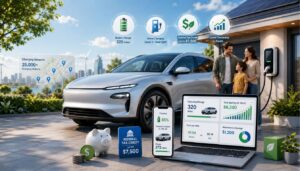
Quick Answer: The total 5-year cost of owning electric car is typically $5,000–$15,000 lower than a comparable gas vehicle for US drivers who charge at home depending on which models you compare and your local electricity and gasoline prices. The key drivers are lower fuel costs, lower maintenance costs, and the federal tax credit of up to $7,500. This guide breaks every cost category down with real numbers.
Electric vehicles are often described as expensive to buy and cheap to run. That framing is partially true and increasingly incomplete. In 2026, EVs span the full price range from $27,000 (post-credit Chevy Equinox EV) to well over $100,000 (Lucid Air Grand Touring). And while running costs are genuinely lower than gas vehicles for most drivers, a few cost categories insurance in particular can erode those savings if you’re not careful.
The right question isn’t ‘Are EVs cheaper than gas cars?’ It’s: ‘For my specific driving situation, income level, and vehicle choice, what will this actually cost me over 5 years?’ This guide by EV Direction answers that question by walking through every cost category with real 2026 numbers.
Category 1: Purchase Price and What You’ll Actually Pay
The purchase price of an EV is the most visible number but often not the most relevant one after incentives. The federal Clean Vehicle Credit can reduce your effective purchase price by up to $7,500 and that math significantly reshapes the comparison with gas vehicles.
The Federal EV Tax Credit: Up to $7,500 for New Vehicles
Under the Inflation Reduction Act, US buyers of qualifying new electric vehicles can receive a federal tax credit of up to $7,500. As of 2024, this credit can be applied as a point-of-sale discount at the dealership you don’t have to wait until tax time. The vehicle and your income must both qualify.
Income limits: The credit phases out above $150,000 AGI (single), $225,000 (head of household), or $300,000 (married filing jointly).
Vehicle MSRP caps: Sedans and wagons under $55,000; SUVs, vans, and trucks under $80,000.
Assembly requirement: Vehicles must be assembled in North America to qualify. Verify eligibility for your specific VIN at fueleconomy.gov before purchase.
| EV Model | Starting MSRP | Federal Credit Eligible? | Effective Price After Credit |
| Chevy Equinox EV LT | $34,995 | ✓ Yes | $27,495 |
| Ford Mustang Mach-E Premium | $47,995 | ✓ Yes (verify) | $40,495 |
| Tesla Model Y Long Range AWD | $48,990 | ✓ Yes (verify) | $41,490 |
| Volkswagen ID.4 Pro S AWD | $46,760 | ✓ Yes (TN assembly) | $39,260 |
| Rivian R1T Standard Pack | $69,900 | ✓ Yes (under $80K truck cap) | $62,400 |
| Hyundai Ioniq 6 SE LR RWD | $38,615 | Check assembly varies | Potentially $31,115 |
| BMW i4 eDrive40 | $53,200 | Check assembly varies | Potentially $45,700 |
| Lucid Air Grand Touring | $138,000 | ✗ No (over MSRP cap) | $138,000 |
Used EV Tax Credit: Up to $4,000
The Inflation Reduction Act also created a credit for used EVs up to $4,000 or 30% of the vehicle price (whichever is less). The vehicle must be at least two model years old and priced under $25,000. Income limits are lower: $75,000 (single), $112,500 (head of household), $150,000 (married).
Used EV opportunity: A 2022 Chevy Bolt EV priced at $18,000 qualifies for up to $4,000 in federal credit, bringing the effective price to $14,000 one of the most cost-effective ways to enter EV ownership.
Category 2: Fuel Costs EV vs. Gas
Fuel savings are the most straightforward financial advantage of EV ownership. The math is simple: electricity costs less per mile than gasoline for virtually every EV/gas car pair.
| Vehicle | Efficiency | Annual Fuel Cost (15K miles/year) | 5-Year Fuel Cost |
| Tesla Model Y Long Range | 4.0 mi/kWh ~$0.040/mile at $0.16/kWh | $600/year | $3,000 |
| Chevy Equinox EV LT | 4.1 mi/kWh ~$0.039/mile | $585/year | $2,925 |
| Hyundai Ioniq 6 SE LR | 4.6 mi/kWh ~$0.035/mile | $525/year | $2,625 |
| Ford Mustang Mach-E | 3.1 mi/kWh ~$0.052/mile | $780/year | $3,900 |
| Toyota RAV4 (gas, 28 MPG) | 28 MPG ~$0.114/mile at $3.20/gal | $1,714/year | $8,571 |
| Honda CR-V (gas, 31 MPG) | 31 MPG ~$0.103/mile | $1,548/year | $7,742 |
| Ford F-150 (gas, 20 MPG) | 20 MPG ~$0.160/mile | $2,400/year | $12,000 |
5-year fuel savings vs. a Toyota RAV4: Tesla Model Y saves approximately $5,571; Chevy Equinox EV saves approximately $5,646; Hyundai Ioniq 6 saves approximately $5,946. Savings vs. an F-150 are even larger up to $9,000 over 5 years for an EV truck.
These figures assume home charging at US average electricity rates ($0.16/kWh) and gasoline at $3.20/gallon. If you rely heavily on public DC fast charging ($0.30–$0.45/kWh), your per-mile fuel cost rises to $0.07–$0.11/mile still cheaper than gas but with a smaller margin. Home charging is essential to the fuel cost advantage.
Category 3: Maintenance Costs
Electric vehicles have fewer moving parts than gas vehicles, which translates directly into lower maintenance costs. An EV has no oil to change, no spark plugs to replace, no transmission fluid to service, and due to regenerative braking significantly less brake wear.
| Maintenance Item | Gas Vehicle (Annual) | Electric Vehicle (Annual) | Notes |
| Oil changes | $120–$240/year | $0 | EVs have no oil. None. |
| Air filter | $25–$50 every 2 years | $0 (motor doesn’t need one) | Cabin air filter still applies ~$20–40/year |
| Spark plugs | $50–$200 every 30–100K miles | $0 | No combustion = no ignition system |
| Transmission service | $100–$300 every 30–60K miles | $0 | EVs use a simple single-speed reduction gearbox with no fluid service |
| Brake replacement | $300–$700 every 40–60K miles | Less frequent often 80–100K+ miles | Regenerative braking recovers kinetic energy instead of burning it off in brake pads |
| Coolant flush | $100–$200 every 2–5 years | ~$50–$150 (thermal management system) | EV battery cooling systems require occasional service less frequent than ICE coolant |
| Timing belt/chain | $500–$1,500 every 60–100K miles | $0 | No timing system in an EV |
| Emissions inspection | $20–$50/year | $0 in most states | Most states exempt BEVs from emissions testing |
Consumer Reports and the American Automobile Association (AAA) have both found that EV owners pay significantly less for maintenance and repairs. Consumer Reports’ owner survey data consistently shows EV maintenance costs 40% lower than equivalent gas vehicles over a 3-year period. The Department of Energy estimates EV maintenance costs approximately $0.06 per mile vs. $0.10 per mile for a gas vehicle.
5-year maintenance savings estimate: Most EV owners save $2,000–$5,000 in maintenance costs over 5 years vs. a comparable gas vehicle, after accounting for tires (same cost) and the occasional EV-specific service item.
Category 4: Insurance Costs
This is where the EV cost advantage narrows. Electric vehicles typically cost more to insure than comparable gas vehicles often 15–25% more due to several factors:
- Higher repair costs: EV components (battery modules, power electronics, specialized sensors) are more expensive to repair than equivalent ICE parts
- Specialized training required: Fewer shops can service EVs, and those that can charge premium labor rates
- Higher vehicle values: More expensive vehicles cost more to insure for comprehensive and collision
- Battery damage risk: A battery damaged in a collision can be very expensive to assess and replace
| Vehicle | Avg Annual Insurance Cost (US) | Notes |
| Tesla Model 3 (2024) | $2,400–$3,600/year | Among the most expensive EVs to insure due to repair costs and Autopilot claims history |
| Tesla Model Y (2024) | $2,200–$3,200/year | Premium varies significantly by state and driver profile |
| Chevy Equinox EV | $1,600–$2,200/year | Lower than Tesla lower repair cost structure |
| Hyundai Ioniq 6 | $1,700–$2,400/year | Competitive insurance rates for the segment |
| Rivian R1T/R1S | $2,800–$4,200/year | High replacement cost = high premiums; improves as repair network matures |
| Toyota RAV4 (gas equivalent) | $1,400–$1,900/year | Reference point lower insurance than most EVs |
Tesla insurance rates vary dramatically by state and driver. In some states with high auto repair costs (California, Florida, Michigan), annual Tesla insurance can exceed $4,000 for comprehensive coverage. Get quotes from multiple insurers State Farm, Progressive, and Travelers often provide more competitive EV rates than companies newer to EV underwriting.
Category 5: Depreciation and Resale Value
EV depreciation has been a mixed story highly brand-dependent and rapidly evolving. The general pattern in 2024–2026 has been:
- Tesla: Retains value better than most EVs but has experienced faster depreciation in 2023–2024 due to multiple price cuts, which reduced used vehicle values
- Chevy Bolt (discontinued): Experienced steep depreciation but is now stabilizing as a used value pick
- Rivian: Strong residual value on R1T/R1S due to high demand and limited production
- Luxury EVs (Lucid, Mercedes EQS): High initial depreciation typical of luxury segment
- Korean EVs (Ioniq 5, EV6): Competitive residuals, improving as NACS/Supercharger access expands
| EV | Est. 3-Year Residual Value | Est. 5-Year Residual Value | Notes |
| Tesla Model Y LR | 52–58% | 38–45% | Multiple price cuts hurt used values; still strong vs. non-Tesla EVs |
| Chevy Equinox EV | 48–55% | 36–42% | Good for a mainstream EV improving with broader adoption |
| Rivian R1T/R1S | 58–65% | 45–52% | Strong demand relative to supply supports residuals |
| Hyundai Ioniq 6 | 45–52% | 34–41% | Improving as network access improves |
| Toyota RAV4 (gas, reference) | 60–65% | 48–54% | Gas SUVs still hold value slightly better this gap is narrowing |
Battery degradation has been much milder than early fears suggested. Most modern EV batteries (2020 and later) retain 85–92% of their original range after 100,000 miles under normal use. Tesla’s Battery Report feature, third-party data from Recurrent, and surveys by AAA all confirm that catastrophic battery failure before the 8-year/100,000-mile warranty period is rare.
Category 6: Financing Costs
EVs finance at similar interest rates to comparable gas vehicles. The key considerations for EV financing:
- The federal point-of-sale credit reduces the amount financed a $48,990 Model Y with a $7,500 credit means financing $41,490, which reduces interest costs over the loan term
- Manufacturer financing offers (0% or low APR) are available on some EVs these can change monthly and are worth checking at the time of purchase
- If you lease instead of buy, the monthly payment structure differs significantly leasing companies typically capture the commercial EV credit regardless of vehicle eligibility under the consumer program, often passing $7,500 in savings through lower capitalized cost
The 5-Year Total Cost of Owning Electric Car vs. Gas (Side by Side)
Here’s what 5 years of ownership looks like for a common comparison: Tesla Model Y Long Range vs. Toyota RAV4 XLE (both are top-selling vehicles in their respective categories). Assumptions: 15,000 miles/year, home charging at $0.16/kWh, gas at $3.20/gallon, purchased outright.
| Cost Category | Tesla Model Y LR ($48,990) | Toyota RAV4 XLE ($31,500) | Notes |
| Purchase price | $41,490 | $31,500 | Model Y after $7,500 federal credit |
| 5-year fuel cost | $3,000 | $8,571 | EV: home charging. RAV4: 28 MPG at $3.20/gal |
| 5-year maintenance | $1,500 | $4,500 | EV: tires + minimal service. RAV4: oil changes, filters, brakes |
| 5-year insurance | $11,000–$16,000 | $7,000–$9,500 | EV insurance premium is a real cost disadvantage |
| Residual value (5yr est.) | -$27,000 | -$17,300 | Model Y at 45% residual; RAV4 at 55% residual (depreciation loss) |
| 5-YEAR TOTAL COST (midpoint) | ~$54,490 | ~$51,871 | Rough totals individual results vary significantly |
This comparison shows a closer race than many expect. The Model Y’s superior fuel and maintenance savings are partially offset by higher insurance costs and a higher depreciation dollar value. The result depends heavily on:
- Your insurance rates (major variable get quotes)
- Local electricity and gas prices
- How many miles you drive (EV savings scale with mileage)
- Whether you take the point-of-sale credit
For high-mileage drivers (20,000+ miles/year), the EV total cost advantage grows substantially because fuel and maintenance savings scale linearly while the cost disadvantages (purchase price, insurance) remain fixed.
Where EVs Win Decisively: High-Mileage, Long-Term Ownership
| Scenario | 5-Year EV Advantage Over Comparable Gas Car | Notes |
| 15,000 miles/year, home charging | $0–$5,000 (break-even to modest savings) | Insurance costs matter most here |
| 20,000 miles/year, home charging | $5,000–$10,000 | Fuel savings scale big advantage for high-mileage drivers |
| 25,000+ miles/year (fleet/rideshare) | $10,000–$20,000+ | Commercial use maximizes every EV cost advantage |
| 7-year ownership vs. 5-year | $8,000–$18,000 | Longer ownership amortizes higher purchase price and insurance over more miles |
| EV truck (Lightning) vs. F-150 Gas | $8,000–$15,000 (5 years) | Gas truck fuel costs are very high EV truck savings are pronounced |
How to Reduce the Total Cost of EV Ownership
Several strategies can improve your EV financial picture beyond just choosing the right vehicle:
Maximize the Federal Credit
- Verify your income qualifies check your prior year adjusted gross income
- Verify the specific VIN qualifies at fueleconomy.gov’s VIN checker before signing
- Confirm the dealer is enrolled in the IRS tax credit transfer program
- If the vehicle doesn’t qualify for consumer credit, explore leasing the commercial credit often flows through as lower payments
Use Time-of-Use Electricity Pricing
Contact your utility and ask about EV-specific rate plans or time-of-use pricing. Charging during off-peak hours (typically midnight–7 AM) can cut home charging costs by 30–50%. A smart charger with scheduling capability pays for itself quickly at this rate differential.
Shop Insurance Aggressively
Insurance costs for EVs vary dramatically by insurer. Get quotes from at least four companies before buying. Tesla has its own insurance product available in many states (Tesla Insurance) which can be competitive. Some EV owners save $800–$1,500 per year by switching insurers after their first renewal when they realize how high the initial quote was.
Maintain the Battery Correctly
Battery health affects both range and resale value. Keep the daily charge limit at 80–90%, avoid regular deep discharges below 10%, and use pre-conditioning in cold weather. Well-maintained EV batteries depreciate slower and command better resale prices.
Look at State and Utility Incentives
Colorado offers a state EV tax credit up to $5,000 on top of the federal credit. California’s Clean Vehicle Rebate Project offers $2,000–$4,500. New York’s Drive Clean Rebate provides up to $2,000. Many utility companies add $200–$1,000 in charger installation rebates. Combined with the federal credit, total incentives can reach $12,000–$15,000 in some states.
Frequently Asked Questions
Is it cheaper to own an electric car than a gas car?
For most US drivers who charge at home, the answer is yes over a 5-year ownership period but it depends heavily on the specific vehicles compared, your local electricity and gas prices, and your insurance costs. Fuel and maintenance savings are reliable and significant. Insurance costs are higher for most EVs. The federal tax credit of up to $7,500 can make the purchase price competitive or even lower than a comparable gas vehicle in some cases.
How much do you save on gas with an electric car?
Most EV owners save $1,000–$1,800 per year in fuel costs vs. a comparable gas vehicle when charging at home at US average electricity rates. Over 5 years, that’s $5,000–$9,000 in fuel savings. The savings are larger for high-mileage drivers and for those coming from gas-hungry trucks or SUVs.
How much does it cost to maintain an electric car?
Electric vehicles cost significantly less to maintain than gas vehicles typically 40–50% less per the US Department of Energy. There are no oil changes, no spark plugs, no transmission service, and significantly reduced brake wear. The main recurring maintenance items are tires (same as gas), wiper blades, and cabin air filter. Expect to spend $300–$700 per year on maintenance vs. $800–$1,500 for a comparable gas vehicle.
How much does EV insurance cost?
EV insurance typically costs 15–25% more than equivalent gas vehicle coverage. For mainstream EVs (Equinox EV, Ioniq 6, Model Y), annual premiums range from $1,600–$3,200 depending on state, driver profile, and coverage level. Tesla vehicles tend to cost more to insure due to higher repair costs. Shop multiple insurers premiums vary significantly and switching can save $500–$1,500 per year.
Do electric cars depreciate faster than gas cars?
The depreciation picture is brand-dependent. Tesla vehicles have depreciated faster than expected in 2023–2024 due to manufacturer price cuts. Rivian holds value well. Most mainstream EVs depreciate at similar rates to comparable gas vehicles, and the gap is narrowing as EV adoption grows. Longer ownership periods amortize the depreciation hit more effectively.
What is the EV tax credit and how do I get it?
The federal Clean Vehicle Credit provides up to $7,500 for qualifying new EVs purchased by qualifying buyers. Income limits apply ($150,000 for single filers). The credit can be applied as a point-of-sale discount at enrolled dealers you don’t have to wait until tax filing. Verify your vehicle’s specific VIN eligibility at fueleconomy.gov and confirm the dealer is enrolled in the IRS transfer program before signing. For details, see our full EV tax incentives guide.
Is leasing an EV cheaper than buying?
Leasing can be cheaper in the short term, particularly for EV models that don’t qualify for the consumer tax credit (vehicles assembled outside North America or above MSRP caps). Leasing companies can take the commercial EV credit regardless of vehicle eligibility and typically pass it through as lower monthly payments. Long-term, buying wins if you keep the vehicle 5+ years and qualify for the consumer credit.